
Measuring Microcracks in uST Complexes: A Digital Method for Structural Integrity Monitoring

The reliability of transport infrastructure is determined not only by the calculated strength of structures but also by the ability to detect even minimal changes in their condition in a timely manner. For uST rail-string complexes designed for decades of operation under constant loads, monitoring reinforced-concrete supports and anchoring units that absorb forces from tensioned strings and rolling stock is especially important.
Engineers at Unitsky String Technologies Inc. have developed a new methodology for measuring crack-opening width that makes it possible not merely to record defects, but to analyze the dynamics of their development with high accuracy – down to hundredths of a millimeter.
Why Microcrack Monitoring Is Critically Important
Cracks in reinforced concrete are a natural result of shrinkage, thermal deformation, and cyclic loading. However, for high-precision engineering systems such as uST transport complexes, what matters most is not the mere appearance of a crack, but the way it evolves over time.
According to current construction standards, the maximum permissible crack-opening width in load-bearing structures is 0.2–0.3 mm. If these limits are exceeded, moisture and oxygen begin to penetrate the concrete, reinforcement corrosion accelerates, and the load-carrying capacity of the element is reduced.
For a “second-level” transport system, in which geometric stability determines the accuracy of unmanned vehicle movement, crack formation control must be part of continuous structural monitoring.
From Visual Inspection to Digital Diagnostics
Traditional methods of crack detection – mechanical probes, magnifying glasses, and indicator gauges – do not provide an objective view of defect progression or accurately capture its dynamics.

The methodology developed at UST Inc. is based on a combination of modern optical and digital technologies, including:
- Macro photography followed by image processing using computer analysis algorithms;
- Digital Image Correlation (DIC) methods for assessing surface deformations;
- High-precision strain gauges installed in areas prone to cracking.
This approach enables the detection of crack openings as small as 0.05 mm, the construction of stress maps of elements, and the tracking of parameter changes over time.
Methodology in Engineering Practice
The methodology employed by engineers at Unitsky String Technologies Inc. includes an algorithm for probing the crack formation zone with selected monitoring points, as well as criteria for assessing defect stability and permissible rates of development. Additionally, it features a digital database of observations integrated into the technical monitoring system of the complex.

This methodology has been tested on the supports of the elevated string rail complexes of uST. Comparison of digital measurements with classical mechanical methods showed discrepancies of no more than 5%, confirming the high accuracy and reliability of the system.
The primary goal of this development is not merely to record a crack but to predict the behavior of the structure under operational load. By understanding the nature of the defect’s opening, it becomes possible to significantly determine the moment when the strength indicators of each specific joint begin to decline.
Predictive Safety of Infrastructure
The new methodology is becoming part of a comprehensive digital monitoring system for the technical condition of uST complexes. In the future, data will be collected in real time directly from the surfaces of supports and beams through a network of sensors integrated with an analytical platform.

This approach shifts infrastructure operation to a predictive maintenance mode – where defects are not addressed ex post but are prevented in the early stages of development.
The project demonstrates how modern transport construction is evolving into a high-precision engineering discipline that measures even microscopic changes in material structure. For the string rail complexes of uST, designed for decades of uninterrupted operation, such monitoring systems are an essential element of reliability.
More news
News
6 September 2021
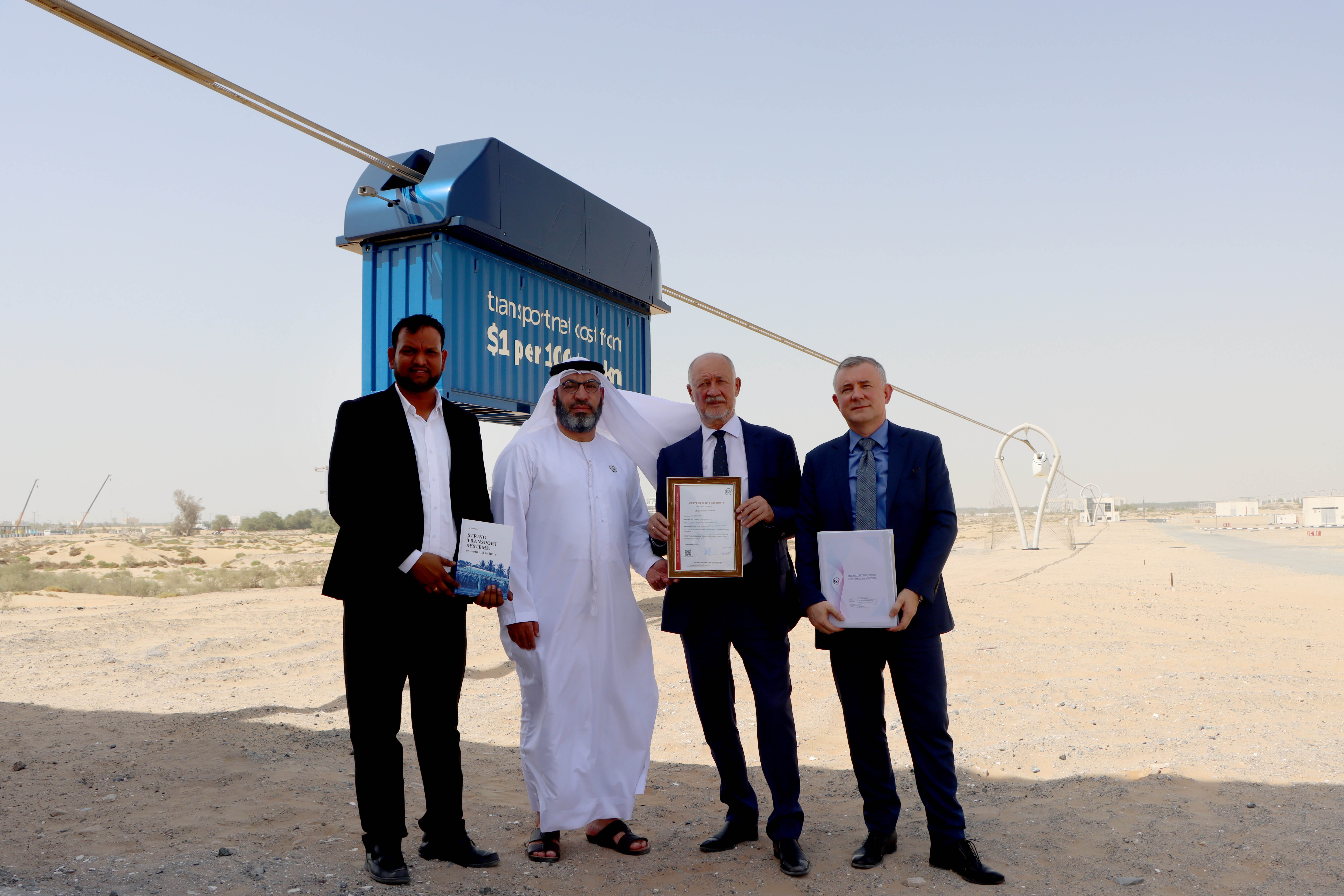
Transport Complex by Unitsky String Technologies Inc. Has Obtained a Certificate of Compliance With the Safety Requirements!
Certification works were being carried out at uSky Test & Certification Centre occupying an area of 28 hectares in Sharjah Research Technology and Innovation Park, UAE.

The commercial projects
15 May 2025
Video Interview on the uST Project in Nepal: Details and Prospects
In a video interview, Oleg Zaretskiy, the CEO of uScovery, unveils key details about the project in Biratnagar and shares his outlook on uST’s future in the country.

Opinion
13 November 2021
Transport Science and Technology Journal Has Published the Article About the Advantages of Passenger String Transport
The UST (Unitsky String Transport) has become a promising mode of transport ready to carry out cargo and passenger transportation. It has been recognized as innovative by the Ministry of Transport of Russia in 2017.


